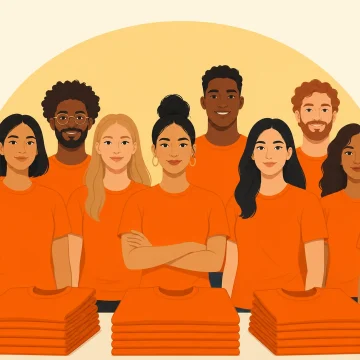
Planning a plain t-shirts bulk order shouldn’t feel like guesswork. Most suppliers hide their pricing behind “request a quote” forms and make buyers negotiate blind. This guide breaks down what actually drives the cost per shirt, how pricing tiers work at different quantities, and what to check before you commit, so you know roughly what to expect before you ever fill out a form.
Why Buying Plain Shirts Wholesale Beats Retail Pricing
Retail t-shirt pricing is built for one person buying one shirt. Wholesale t-shirts work differently. When a supplier prints or packs a large batch at once, fixed costs like screen setup, order processing, and shipping logistics get spread across many more units. That’s why the per-shirt price drops as the order size grows, even though the shirt itself hasn’t changed.
Fabric buying power matters too. Suppliers who purchase blank tees by the case or pallet get better rates from mills than someone buying a handful of shirts at a time. Some of that savings gets passed down when you order t-shirts in bulk. That’s the core economic reason plain shirts wholesale pricing looks so different from a retail rack.
None of this means bulk orders are only for huge companies. The savings kick in earlier than most people assume, often starting around a couple dozen units.
Who Actually Needs a Bulk Plain Tee Order
Bulk plain tee orders come from a wider range of buyers than people expect. Small businesses ordering staff uniforms, youth sports leagues outfitting a team, wedding parties, church groups, school clubs, and resellers stocking blanks for their own print shop all land in this category. A 20-person company retreat ordering matching plain tees typically lands in a very different per-unit price bracket than a 500-piece wholesale reseller order. That gap is exactly why quantity tiers matter more than most buyers realize. If your group is smaller than a dozen, a no-minimum option may fit better than a bulk tier, and it’s worth comparing no minimum order custom t-shirts before you commit to a bulk quantity you don’t need.
Plain T-Shirts Bulk Order Pricing Table by Quantity
Here’s the part most competitors leave out: an actual sense of how pricing moves as quantity increases. The numbers below are illustrative rather than a live price list, since exact rates depend on fabric, color, and print method. They reflect the pattern you should expect to see from a transparent supplier.
| Quantity Tier | Typical Use Case | Relative Per-Unit Price | Notes |
|---|---|---|---|
| 12–24 units | Small teams, family events, small business staff | Highest per-unit rate in the bulk range | Setup costs are split across the fewest shirts |
| 25–99 units | Sports leagues, school groups, mid-size events | Noticeably lower than the small-team tier | Sweet spot for many first-time bulk buyers |
| 100–499 units | Corporate departments, large events, resellers | Lower still, meaningful step down | Volume discounts on fabric start to show clearly |
| 500+ units | Wholesale resellers, large enterprise orders | Lowest per-unit rate | Best suited to buyers with recurring or large-scale needs |
Bulk apparel discounts commonly scale in steps of roughly 10-30% as order size moves from small team quantities into wholesale-level volumes, though exact figures vary by supplier and fabric weight. The general rule holds across most plain t-shirt suppliers: every jump to the next tier brings the per-unit cost down, even if the drop-off shrinks a bit as you move into the largest volumes.
Small Team Orders (12-24 Units)
This is the entry point for most bulk plain tee order pricing. Twelve to 24 shirts is enough to trigger volume pricing but small enough to fit a single department, small team, or family event. Expect the per-unit price here to sit at the top of the bulk range. You’re saving over retail, but you haven’t yet hit the deeper discounts that come with larger production runs.
Mid-Size and Wholesale Tiers (25-499+ Units)
Once an order crosses into the 25-99 range, the per-unit price usually drops in a way that’s noticeable on the invoice, not just on paper. Youth sports leagues, church groups, and small businesses ordering team shirts often need 25-50 units with next-week turnaround, which makes this tier the most common real-world bulk buyer profile. Orders of 100-499 units generally come from corporate departments, larger events, or resellers, and this is where fabric buying power really starts to show up in the price. At 500 units and above, pricing typically flattens out at its lowest point. That’s why this tier is aimed at wholesale resellers and businesses with recurring, high-volume needs rather than a one-off event.
How to Order T-Shirts in Bulk Step by Step
Ordering in bulk is more structured than a normal retail purchase, but it doesn’t need to be complicated. The typical workflow looks like this:
- Request a quote. Share your target quantity, sizes, colors, and any print or design needs.
- Confirm sizing. Review a size chart against your group’s actual measurements, not just guesswork, especially for youth or unisex fits.
- Approve a proof. If you’re adding a logo or text, you’ll usually see a digital proof before production starts.
- Lock in production timeline. Confirm turnaround time in writing, especially if you’re working toward an event date.
- Production and shipping. Once approved, the order moves into production, then ships as a batch or in split shipments if needed.
Being specific at the quote stage saves time later. The more detail you give upfront, the fewer back-and-forth emails you’ll need before production starts.
Choosing Sizes, Colors, and Fabric for Group Orders
Team t-shirt orders almost never come in a single size. A reliable supplier will let you mix sizes and, in many cases, colors within one bulk order, as long as the total quantity meets the minimum. Fabric choice matters too: heavier cotton tends to hold up better for everyday uniform use, while lighter blends work well for event giveaways or hot-weather sports. If you’re also considering printed designs rather than solid colors, it’s worth looking at comparing t-shirt brands for quality and value before you finalize a blank style, since fabric weight and fit vary noticeably between manufacturers.
Bulk Plain Tees for Teams, Events, and Businesses
Bulk plain tees serve a wide range of buyers, and the right order strategy differs depending on the goal.
- Corporate teams often need consistent branding across departments, with reorders throughout the year as staff changes.
- Sports leagues need durable, breathable fabric and fast turnaround before game day.
- Event organizers (weddings, fundraisers, reunions) usually need a one-time order with a firm delivery date.
- Resellers and small print shops buy plain blanks in wholesale quantities, then add their own designs before selling.
If your event calls for something more playful than a plain tee, pairing a bulk order with funny t-shirts for group gifting is a common way to add variety without abandoning the bulk pricing structure. Some buyers also blend a plain t-shirts bulk order for the group with a smaller batch of custom-printed pieces for organizers or VIPs.
What to Check Before You Place a Wholesale T-Shirt Order
Before committing to a wholesale t-shirt order, run through a short checklist. It’s the difference between a smooth order and a frustrating one.
- Minimum order quantity. Confirm the supplier’s minimum matches your group size. Some start as low as a dozen units, others require higher minimums for wholesale-only pricing.
- Turnaround time. Ask for a specific production and shipping window, not a vague estimate, especially if you’re working around an event date.
- Reorder flexibility. If you’ll need more shirts later, say new hires or a growing team, confirm whether reorders match the same pricing tier or reset to a smaller quantity.
- Size and color mixing. Confirm in writing whether you can combine sizes and colors within a single order.
- Sample or proof process. A supplier that offers a proof before full production reduces the risk of costly mistakes.
Minimums, Turnaround Times, and Reorder Flexibility
Minimum order quantities and turnaround times are where reliable wholesale suppliers separate themselves from riskier ones. A supplier that’s vague about minimums, won’t commit to a delivery date, or can’t explain how reorders are priced is a warning sign. Look for clear answers to all three questions before you place a deposit, not after.
Get Your Custom Bulk Quote Today
Transparent pricing shouldn’t be the exception in the wholesale t-shirt business. It should be the standard. Whether you’re outfitting a 20-person office team or placing a 500-unit wholesale order, knowing roughly what to expect at each quantity tier makes the decision easier and the negotiation shorter.
If you’re ready to move forward with a plain t-shirts bulk order, request a custom quote with your group size, sizing needs, and timeline. A clear quote, built around your exact quantity, is the fastest way to lock in real pricing instead of guessing from a generic price list.